 woodspick.
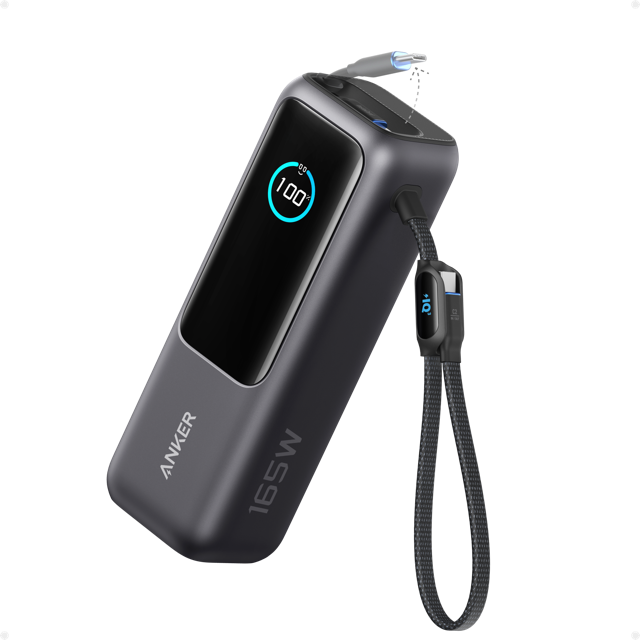
Useful laptop reserve, if the cable layout fits
Consider the A1695 for regular laptop use away from an outlet, particularly when attached cables remove a real inconvenience. Its single USB-C ceiling is 100W; 165W applies to two USB-C devices together. The size and weight make less sense if the daily task is only a short phone top-up. Match the port combination to your devices before choosing.
Reasons to consider it. Things to check.
What stands out
- Two built-in USB-C cables reduce the need to pack separate leads.
- Three USB-C connections and USB-A accommodate a mixed device kit.
- A display shows the charging setup and remaining battery status.
Limitations
- 595g is a substantial addition to a phone-only carry kit.
- Three or four connected devices share a lower 130W total ceiling.
- Built-in cable condition and reach are part of the ownership tradeoff.
The specifications that matter
| Exact model | A1695 |
|---|---|
| Cell capacity / energy | 25,000mAh / 90Wh |
| Connections | 2 built-in USB-C cables; 1 USB-C socket; 1 USB-A socket |
| USB-C output, one connection used | Up to 100W from each USB-C cable or socket |
| USB-A output, used alone | Up to 33W |
| Two USB-C devices | Up to 165W combined |
| One USB-C and one USB-A device | Up to 133W combined |
| Three or four devices | Up to 130W combined; allocation depends on the combination |
| USB-C input | Up to 100W; peak recharge rating requires battery level above 25% |
| Dimensions | 6.18 × 2.12 × 1.93 in / 156.97 × 53.85 × 49.02mm |
| Weight | 21oz / 595g |
Start with the time you spend away from an outlet
The A1695 makes the most sense when a laptop is part of your everyday bag. A phone-only commute rarely needs the same reserve as an afternoon of computer work between meetings. Write down what you need to keep running and for how long before deciding that a larger battery is worth carrying.
Start with the laptop's supported USB-C charging input, then consider its workload. An adapter that meets your needs while reading documents may leave less headroom during demanding work. Buying a larger power bank also adds something that needs charging before the trip, so it should solve a recurring problem rather than an occasional worry.
Built-in cables are the main reason to choose this design
The two attached USB-C cables make the A1695 worth considering if forgetting a cable has interrupted your day. One retracts into the body; the other forms a short loop. A separate USB-C socket and USB-A socket leave room for devices that need a different cable.
Macworld's review particularly values the integrated cables and informative display. Those are useful observations for someone trying to simplify a travel kit. Our buying judgment is narrower: convenience matters most when the included connectors and lengths actually reach your devices in their normal positions.
For a laptop on a table, check where its charging socket sits. For a phone in a jacket pocket, consider where the battery will rest. Keep an appropriate separate cable if either built-in arrangement would pull against a connector. Attached cables reduce packing decisions, but they also make cable condition part of the long-term ownership decision.
The 165W headline applies to a particular combination
Anker's current US specifications give each USB-C connection a 100W single-device ceiling. Two USB-C devices can share up to 165W; USB-C plus USB-A has a different combined ceiling of 133W. Connecting three or four devices lowers the total maximum to 130W.
For a laptop-and-phone pair, the useful question is how much each can receive together. Check the diagram for the connections you intend to use, especially before adding another accessory. A spare socket does not reserve extra power beyond the shared ceiling.
The display can help you see the current arrangement, but a number on a screen is not a promise about the next hour of charging. Devices change their requests as battery levels and workloads change. If your laptop needs more than the available single-device output to maintain its charge, the larger total rating does not remove that mismatch.
Plan how you will refill it
The power bank supports up to 100W USB-C input. Anker qualifies that peak: its battery level must be above 25%. Treat the rating as a supported ceiling, rather than a constant rate from empty to full.
A suitable wall charger remains part of this setup. The Anker Prime 100W charger is an option to consider for refilling the bank from an outlet, provided the chosen connection and cable support the required input. Its own multi-device limits still matter if a phone or laptop is connected alongside the bank. The 65W versus 100W guide helps you decide whether replacing an existing adapter serves a practical need.
Anker also documents conditions for charging other devices while refilling the bank. Its pass-through support guidance requires at least 20W input and limits output according to the incoming power. Do not plan around maximum recharge and maximum device output happening together.
Decide whether the reserve earns its weight
At 595g, this belongs in a bag you are prepared to carry. Its 90Wh cell-energy rating is useful for comparing stored energy, but conversion losses mean it cannot deliver all of that energy into a laptop battery. Avoid treating a capacity division as a guaranteed number of full charges.
For phone-led days, the UGREEN MagFlow 25W addresses a different need: keeping a smaller charging setup near the phone. Choose the Anker when laptop support and attached cables justify the bulk. For the broader capacity, connection and travel questions, use the power bank buying guide before choosing a size.
Who this is for
Someone who regularly takes a compatible USB-C laptop and phone away from outlets, wants attached cables, and can accommodate the weight in a bag.
Consider something else if…
A compact phone battery covers your routine, the built-in leads will not reach your normal setup, or the laptop requires more than 100W from its chosen connection.
Sources
Model details checked November 1, 2026. Output, capacity and recharge figures are manufacturer ratings with stated conditions. Named media observations are attributed in the article.